The owner bills all day
Journals are the CA’s language. The product should start at the tax invoice.
Accounting
Billing that posts into books. Startup is free. Ledgers and trial balance are on SMB — not a Tally classroom.
₹0
Invoices plus P&L and outstanding
SMB
Ledgers and trial balance
Honest
Not Tally. Not GSTR-1 filing. Not IRN
What it is
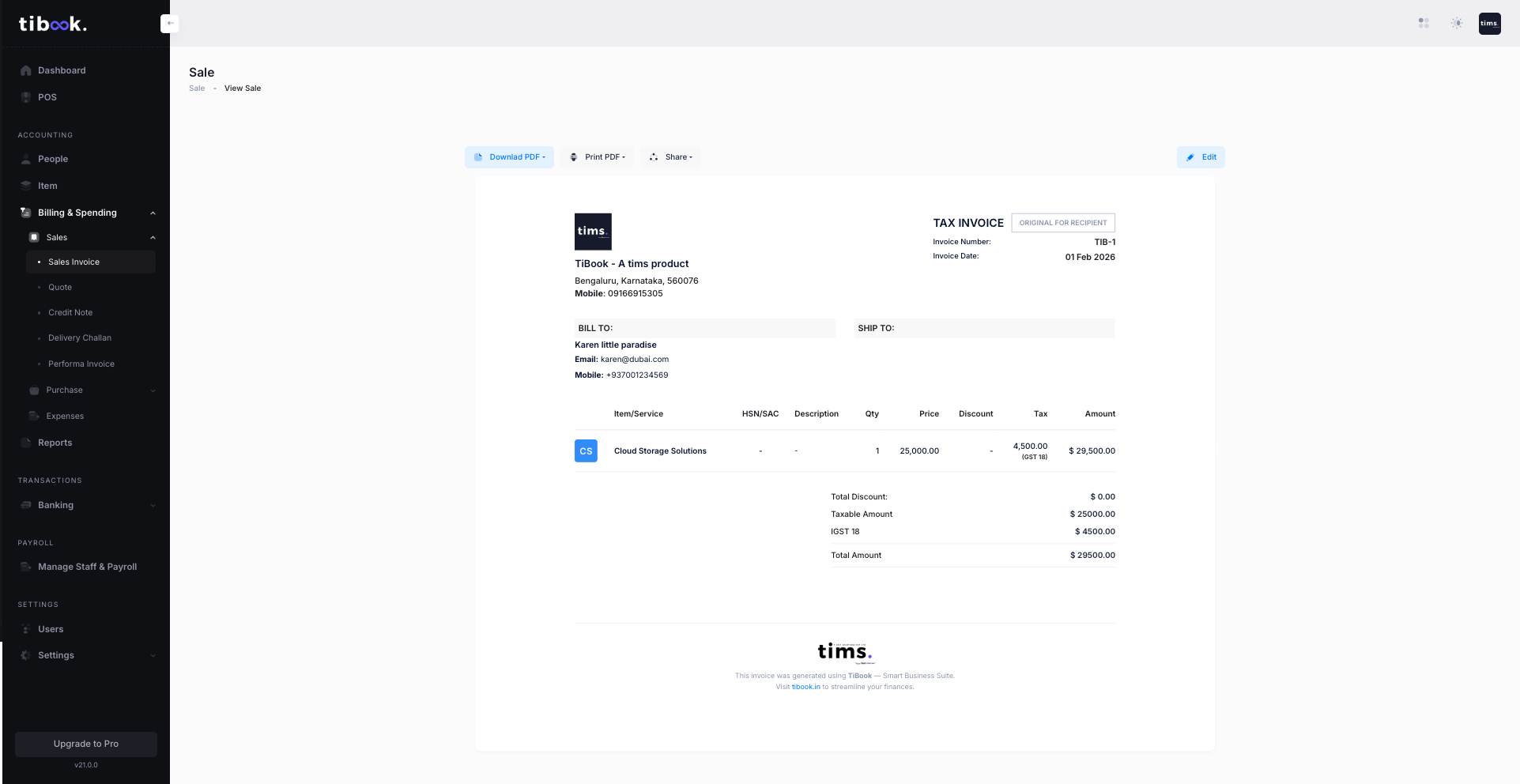
Accounting software for small business in India has to start with the GST invoice, not a journal the owner is afraid to touch. TiBook records sales, purchases, expenses, and payments as documents. Reports come from those documents.
Competitors often sell “generate GSTR-1 and e-invoice from the same click.” We do not file returns or mint IRNs. Your CA files from invoices and reports you already have.
Not Tally. No GSTR-1/3B filing. No promised Tally XML export. Recurring invoices are Enterprise.
Why it matters
Journals are the CA’s language. The product should start at the tax invoice.
The invoice is the source document.
Cloud access beats a dongle on a dying PC.
We do not. Your CA files. IRN is the portal or a GSP.
How to
Sales, purchases, expenses, payments. That is the book.
P&L, daybook, outstanding.
Chart of accounts, journals, trial balance. Same invoices.
Extra users. They file on the GST portal from your documents.
We do not promise an export that recreates Tally.
Guides: Enable accounting · Bookkeeping · GST billing
Product
Profit and loss, daybook, outstanding. Enough for many shops until they need a chart of accounts.
Chart of accounts, journals, ledgers, trial balance at ₹199/month — same GST invoices, not a second product.
Sales invoices, purchase bills, credit notes, receipts, and payments. Journals when you need an adjustment.
Shops use stock. Service firms skip it. Same company.
Browser and apps. Not a local Tally data file as the only copy.
Invoice-first
Owner can bill without a voucher course.
Filing honesty
Documents for the CA vs fake one-click filing.
Plan you can explain to a shopkeeper
₹0 / ₹199 / ₹399.
| Need | Tally | TiBook |
|---|---|---|
| Owner daily use | Operator. | Invoice UI. |
| Trial balance | Native. | SMB. |
| GST return | With CA / tools. | CA + portal. We do not file. |
| IRN | Add-ons / GSP. | Not generated. |
Pricing
Start on Startup. Add SMB for POS, payroll, and ledgers. Recurring is Enterprise.
Startup
₹0
GST invoices, quotations, delivery notes, expenses, payments, basic inventory, P&L, daybook, outstanding. No credit card.
SMB
₹199/mo
Retail and Restaurant POS, payroll, extra users, and the accounting app (ledgers, journals, trial balance).
Enterprise
₹399/mo
Everything on SMB plus automated recurring invoices.
Full comparison on pricing.
Shops, traders, and service firms that want GST billing and readable books. CAs still file returns.
Not Tally. No GSTR-1/3B filing. No promised Tally XML export. Recurring invoices are Enterprise.
Free to bill. Ledgers on SMB. Filing stays with your CA.